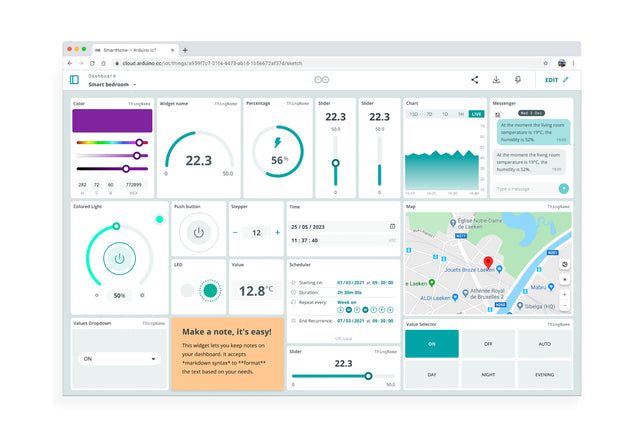
Once a vehicle is handed to an operator, its value depends not only on the hardware itself but on how much usable data it generates — and whether that data can be turned into operational decisions. The fasfab EV AIoT platform is built for exactly this: connecting the data path from vehicle to cloud, and exposing the results to fleet systems as APIs.
Layered architecture: from edge to cloud
- Edge: the on-vehicle terminal collects motor, controller, battery and vehicle data, performs local preprocessing and buffering so nothing is lost on weak networks
- Transport: encrypted upload channels with resumable transfer and traffic optimization, balancing data integrity and communication cost
- Cloud: device connectivity, time-series storage, state computation and alarm evaluation — the platform's core compute and storage layer
- Application: fleet dashboards, vehicle location, geofencing, billing and settlement for operators

Core capabilities
1. Full-domain telemetry and diagnostics
The platform continuously collects operating parameters and fault codes, raising graded alerts on abnormal states. Operators can intervene before an issue becomes downtime — shifting from repair-after-failure to action-before-failure.
2. Battery and health management
Using cell voltage, temperature and charge-discharge history, the platform continuously assesses battery health, informing maintenance scheduling and battery asset decisions.
3. OTA remote updates
Controller firmware and feature configuration can be updated remotely without bringing vehicles back to a service point, greatly reducing the time and labour cost of version maintenance.
4. Big data analytics
Aggregating riding behaviour, energy curves and fault distribution produces conclusions usable for both vehicle improvement and operational optimization.

Open integration: your data, your systems
Fleet operators usually already run their own dispatch or settlement systems. The platform provides standard APIs and SDKs to bring vehicle status, location and event data into third-party systems, and supports branded customization of the rider app — avoiding new data silos.
Security and scalability
The platform is systematically designed around device authentication, channel encryption, tiered permissions and operation auditing. On capacity, it supports large-scale concurrent device access, leaving headroom for fleet growth.
Conclusion
Hardware determines whether a vehicle can run; the platform determines whether a fleet can run efficiently. fasfab EV continues to invest in AIoT platform capabilities, with the goal of turning vehicle data into an operational asset partners can use directly.